How to Plan a Company Away Day: Step-by-Step Guide

If you’ve been asked to plan a company away day, it can feel like a lot to pull together. It gets much easier once you break it into a few smaller jobs and take them in order.
Start by deciding what the day is for, then fix the date, budget and headcount. Choose a format and venue to suit, build the agenda and pick activities that match your goal. Then sort food, access and travel, tell everyone what to expect and run the day to a schedule.
Work backwards from the date and the whole thing takes about eight weeks. If you want help with the activity side, our team building events are built for exactly this.
Step 1: Decide what the day is for
Choose one primary goal before you look at a single venue. The usual options are to help people connect, to plan or solve a business problem, to train, or to reward the team. A day that tries to do all four often does none of them well.
Write the goal as a sentence, then decide how you will know it worked: a feedback survey, a list of agreed actions, or two teams who rarely speak now doing so.
Step 2: Set the date, budget and headcount
Agree these three numbers first. Check the date against leave, quarter-end deadlines and school holidays, and count remote colleagues too.
Set a budget per head and a contingency, and know what it must cover: venue, activities, food, travel and any materials. Get quotes in writing, ask what is included, and check whether setup, equipment and a host are part of the price or extras.
Step 3: Choose the format and venue
Your three main options are in the office, off-site indoors, or outdoors. The right answer depends on your goal, group size and how much you want people to feel away from their desks.
- In the office: cheapest and simplest, but people get pulled back to email.
- Off-site indoors: a hotel, meeting space or hired venue. Best for workshops plus an activity.
- Outdoors: good for active, social days, but you need a wet-weather plan.
Check the room before you commit: capacity, step-free access, power, projector and screen, breakout space and the time you can get in to set up. We offer a free venue finding service as standard with our corporate events, so you do not have to shortlist venues yourself.
Step 4: Build the agenda
Build the agenda around your one goal and keep it looser than you think you need to. Over-packed schedules tend to overrun, so leave room for the activity and the conversations between sessions.
Sample agenda
| Time | Item |
|---|---|
| 09:30 | Arrival, tea and coffee |
| 10:00 | Welcome, goal for the day and an icebreaker |
| 10:30 | Work session (planning, strategy or training) |
| 12:00 | Lunch |
| 13:00 | Interactive team activity |
| 15:00 | Workshop: turn ideas into actions |
| 16:15 | Wrap-up and feedback |
| 16:45 | Close |
Icebreakers to open the day
Keep the opener to 10 to 15 minutes and make it easy to join. Good options are two truths and a lie, a pairs interview where each person introduces their partner, or a quick team name challenge. Mix people across teams, and avoid anything that asks for personal disclosure.
Step 5: Pick activities that fit the goal
Match the activity to the goal first, then check it against your group size and space. A work session suits planning or training. A team-building activity suits connection or reward.
| Goal | Activity type | Group size | Space |
|---|---|---|---|
| Connect new or merged teams | Indoor team building (CSI Investigation, Escape Room in a Box) | 10 to 100+ | Indoor space; confirm with the supplier |
| Energise a large group | AI Robot Wars | Teams of 6 to 12, up to 500 people | Tailored from a small arena to a giant race track |
| Problem-solving under light pressure | VR Escape Room | Teams of 4 to 10, up to 500 people | About 2 x 2 m per team (a table) |
| Active, social day | Outdoor team building | Varies by format | Outdoor space |
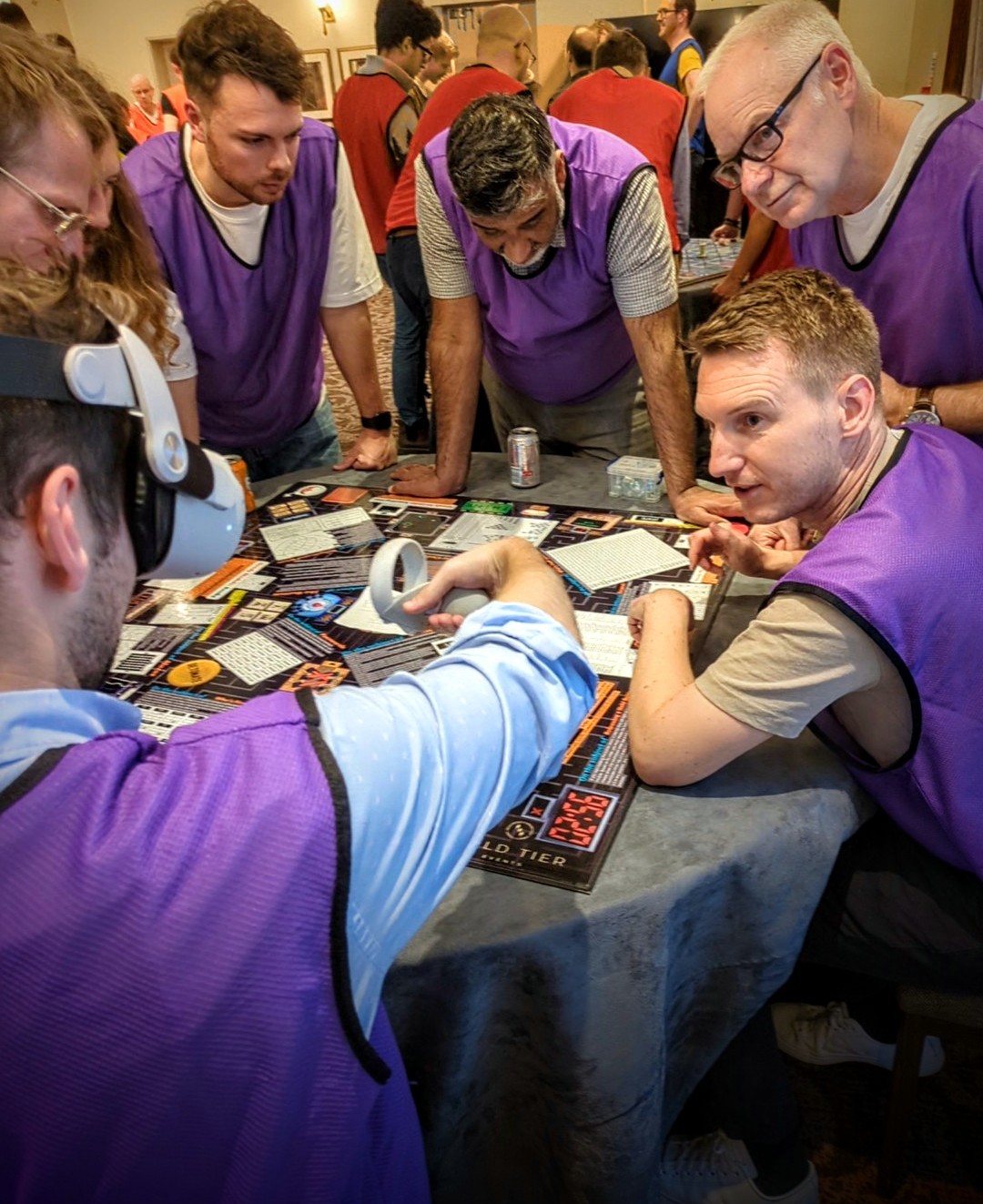
Robot Wars needs no AI, robotics, coding or VR experience, and the VR Escape Room needs no VR experience, so nobody is left out. Ask any supplier what they need on the day: setup time, floor space per team, power and AV. Outdoor activities add insurance, safety and weather questions, so confirm those with the supplier rather than assuming.
Step 6: Plan inclusion, food and travel
Ask everyone about dietary needs and access requirements when you send the invite, not the week before. Offer a good non-alcoholic option, since not everyone drinks and a bar-led evening can exclude people.
Give neurodiverse colleagues the agenda in advance and a quiet space to step out to, and choose activities that do not depend on physical ability. If some people are remote or hybrid, give them a meaningful role or a parallel session, not a laptop at the end of a table.
Sort travel early: start times that suit commuters, clear directions and a plan for late arrivals.
Step 7: Communicate, then run the day
Send a clear invite early with the date, times, location, dress code, what the day is for and who to contact. Follow up a week before with the final agenda.
On the day, have one named contact, a printed running order and someone to greet people. Arrive early to check the room and AV, and agree the supplier’s arrival and setup time in advance.
How to plan a company away day: the 8-week timeline
| When | What to do |
|---|---|
| 8 weeks before | Agree goal, date, budget and headcount |
| 7 weeks | Shortlist venues and activity suppliers, request quotes |
| 6 weeks | Book venue and activity; send a save-the-date |
| 5 to 4 weeks | Draft the agenda; collect dietary and access needs |
| 3 weeks | Send the full invite; confirm catering and travel |
| 1 week | Confirm final numbers, setup times and running order |
| Day before | Check room, AV, signage and the supplier’s arrival time |
| Day | Run to the agenda; keep one named contact |
| 1 week after | Send feedback survey; share actions |
Common mistakes
- No clear goal. If you cannot say what the day is for, the team will not know either.
- The wrong room. Too small, or no space for an activity.
- An over-packed agenda. Cut sessions rather than shortening them all.
- No wet-weather plan for outdoor days.
After the day: feedback and follow-up
Send a short survey within a week, asking about the goal you set in step one. Share the agreed actions with owners and dates.
When to bring in a supplier
Bring one in when you need equipment or AV, or do not have time to manage logistics yourself. With our corporate events, setup, breakdown and all equipment are provided, along with professional hosts and a free venue finding service. We deliver events across the UK, for groups from 20 people to 2000.
“Gold Tier arrived at the exact time they said they would, they set everything up ready for the start of our event.” — Diane Collins, Business Developer, Howdens
FAQs
What are some good icebreakers for a team away day?
Pick something quick that needs no preparation from guests: two truths and a lie, a team name challenge, or a short pairs interview where each person introduces their partner. Keep it to 10 to 15 minutes, mix people from different teams, and avoid anything that forces personal disclosure.
What are some fun activities to do at team meetings?
For shorter sessions, use a quiz, a quick puzzle round or a small-team challenge that fits in 20 to 30 minutes. For a full away day, choose a longer interactive format such as a game show, an escape room or a robot battle, and match it to your room and headcount.
How many people should be in each team activity group?
Most team formats work best with small groups. Our AI Robot Wars runs in teams of 6 to 12, and our VR Escape Room in teams of 4 to 10. Smaller teams mean everyone contributes; larger ones suit looser, free-flow formats.
How far ahead should you book an away day?
As early as you can. Eight weeks is a sensible target for a standard away day, because it leaves time to agree the goal and budget, secure a venue and activity, and give staff proper notice. Larger groups, school holidays and December dates need longer.
Tell us about your event and we’ll put together a tailored proposal. Enquire here.