Wedding Planning Checklist: UK Timeline, Month by Month

You’ve got engaged, or you’ve been asked to help someone who has, and now there’s a long list of things nobody explained. A wedding planning checklist turns that into an order of play. In the UK, the order is: set a budget, guest list and date, then book the venue. Next come your main suppliers and legal notice, and the detail follows in the final weeks.
This checklist runs from 12 months out to the day itself. It also covers two things many lists leave out. One is the UK legal steps. The other is the evening, once the speeches are over and the room needs to work as a party. We plan and run events across the UK.
How far ahead should you start planning?
Aim to start about 12 months out. That gives you the widest choice of venues and dates without rushing any decision. Shorter timelines work, but you’ll have fewer options, particularly for summer Saturdays.
If you only have a rough idea of when you want to marry, begin with the first three items below (budget, guest list, date range). Everything else depends on them.
12+ months out: budget, guest list, date and venue
Do these four in order, because each one limits the next.
- Agree a budget. Work out what you can spend, who (if anyone) is contributing, and what matters most to you. Write it down in pounds, and keep a buffer for the things you haven’t thought of.
- Draft a guest list. Guest numbers drive the venue, catering and every per-head cost. A rough number is enough for now: A-list, B-list and “if there’s room”.
- Pick a date range. Choose two or three possible dates, not one. Flexibility on the day of the week or the month can widen your venue options.
- Visit venues and book one. Ask what’s included, what time you have to finish, and whether you can bring your own suppliers. Ask where the evening party happens and whether there’s a noise limit.
Put your checklist somewhere you can both see it, such as a shared spreadsheet or a printed sheet on the fridge. A simple wedding planning checklist you actually update beats a beautiful one you don’t.
9–12 months out: book the priority suppliers
The suppliers who can only do one wedding a day need booking early. Book these first, and leave the rest until later.
- Photographer and, if you want one, videographer
- Caterer, if your venue doesn’t provide food
- Celebrant or officiant, if your ceremony isn’t at the venue’s registrar
- Band, DJ or other main music
- Wedding insurance, once you’ve paid your first deposits
Read every contract for the cancellation terms, deposit schedule and what happens if you change your guest numbers. Keep a note of each payment date in one place.
6–9 months out: design, guests and the evening plan
This is the stretch where it feels like plenty of time, then suddenly isn’t. Use it to lock in the look, the guest experience and the shape of the day.
- Choose your outfits and book fittings with enough slack for alterations.
- Set up a wedding website or shared page with the date, venue, travel and accommodation details.
- Send save-the-dates, especially if guests are travelling or need to book time off.
- Block-book or recommend accommodation near the venue.
- Book florist, stationery, cake and transport.
- Plan the evening. Decide now whether the party is a DJ and a dance floor, or something more than that. More on that below.
3–6 months out: invitations and legal notice
Send invitations roughly three to four months before the day, with an RSVP date well ahead of your caterer’s final-numbers deadline. Chase replies once the date passes. People forget, and you need the numbers.
Give notice of marriage. In England and Wales, you both give notice at your local register office, and there is a waiting period before the ceremony can take place. Scotland and Northern Ireland have their own rules, and the process for marrying abroad is different again. Check the current requirements on GOV.UK and with your register office, because they involve ID, proof of address and fees, and they can change. Don’t leave this to the last month.
Also at this stage:
- Order rings, and book hair, make-up and trials.
- Confirm dietary and accessibility needs with guests, and pass them to your caterer and venue.
- Start the seating plan draft, however rough.
- Book the honeymoon, and check passport validity.
1–2 months out: confirm everything
Contact every supplier and confirm date, time, address, contact name and what they need from you. Write it all on one running order, then share it with whoever will be on the day.
- Chase outstanding RSVPs and confirm final numbers with your caterer.
- Finalise the seating plan and table names.
- Do final dress and suit fittings.
- Write your vows and speeches, and agree who is speaking and in what order.
- Pay balances due, and prepare any tips or envelopes for the day.
- Give a supplier arrival timetable to your venue contact so they know who’s turning up when.
The final weeks and the week of the wedding
In the last two to four weeks, you’re tying up loose ends rather than making big decisions. Print the running order, make a list of who to call for each supplier, and pack an emergency kit.
In the final week:
- Check the weather forecast and have a wet-weather plan if any part of the day is outdoors.
- Hand over decorations, place cards, gifts and signage to the person delivering them to the venue.
- Delegate. Name one trusted person to be the point of contact for suppliers so it isn’t you.
- Eat, sleep and don’t make new decisions the night before.
Can you plan a wedding in three months?
Yes, if you keep the guest list small and stay flexible. The legal notice period is a fixed waiting time, so give notice first. Then book venue, food and photographer in the first fortnight, and accept that your first-choice date or supplier may be gone.
What changes on a short timeline is how many decisions you make, not the order. Cut anything that isn’t essential: bespoke stationery, large guest lists and lengthy trial runs are the first to go.
What’s a realistic UK wedding budget?
A realistic budget is whatever you can afford, divided by what matters most to you. Averages are a poor guide because costs vary so much by region, season, day of the week and guest count, so we won’t quote one here.
A method that works:
- Set a total you’re comfortable spending, including any family contributions.
- Rank your priorities. Pick the top three: food, venue, photography, music, whatever you’d regret cutting.
- Get quotes for the big items first. Venue and catering are usually the largest, so they shape what’s left.
- Check what’s included. VAT, service charges, corkage and overtime can change a quote.
- Keep a contingency. Something will cost more than you expected.
Update the sheet each time you pay a deposit, so you always know what’s left.
What most checklists skip: planning the evening
Most checklists end the party at “first dance”. The evening is where guests who don’t know each other need something to do, and it’s the part of the day where entertainment matters most.
We run interactive entertainment for corporate events and private parties, including weddings. A room of 100 guests with a dance floor and a bar works well for some groups. For others, there’s a long gap between the cake and the late dancers, and the room splits into cliques.
Things to decide before you book the music:
- Who’s in the room? Mixed ages and two families who’ve never met suit shared games better than a dance floor alone.
- How will the room flow? Think about where people gather, where queues form, and whether an activity pulls people away from the bar or toward it.
- What’s the space? Ask your venue about floor space, power and noise limits. A venue’s rules always come first.
- What about guests who don’t drink or don’t dance? Offer something to do that isn’t either.
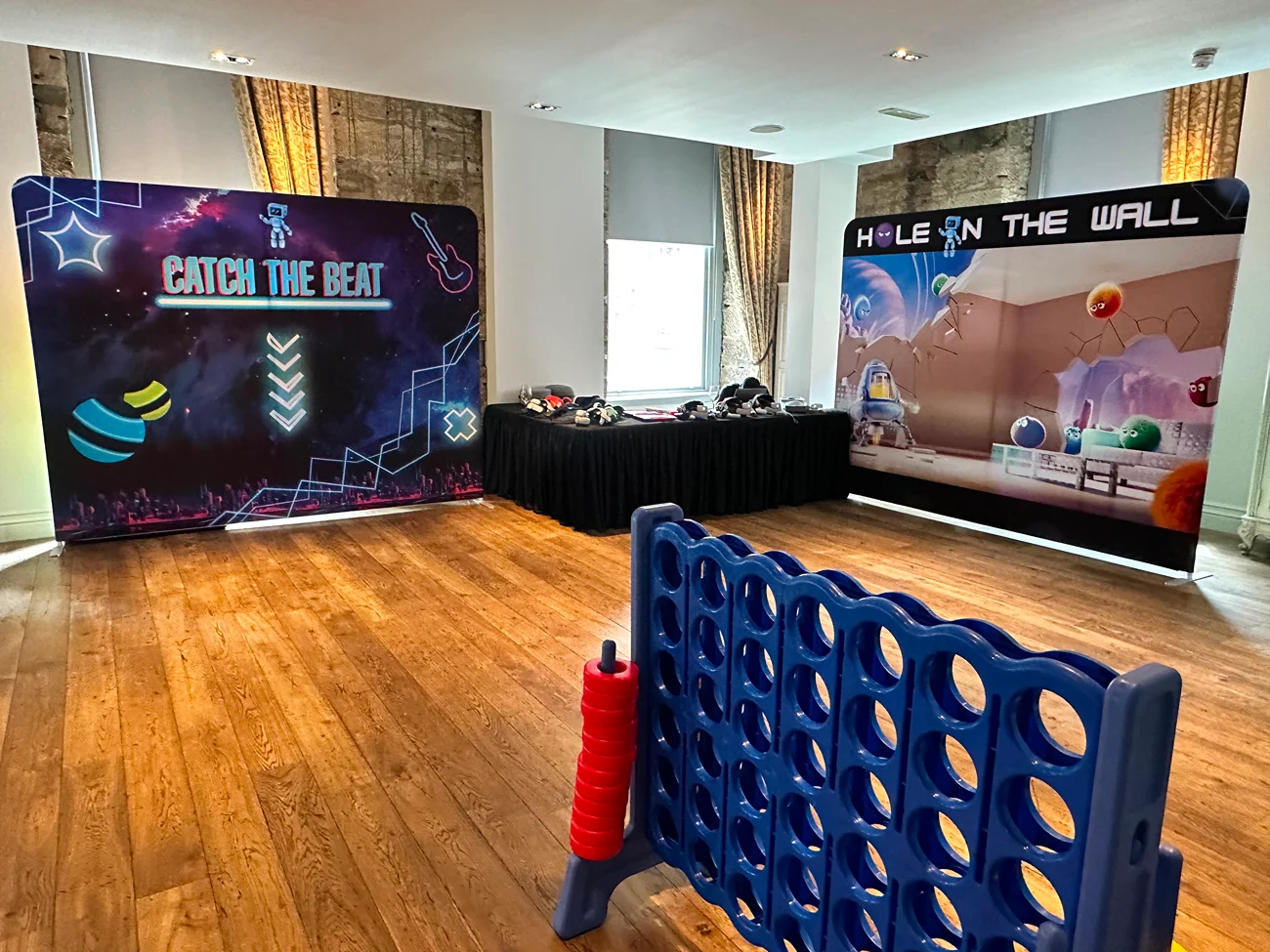
Options that work in an evening setting include arcade-style games, game-show formats and group games with a host. The Betrayers, our game inspired by The Traitors, is one we adapt to the room and the group size, with a professional presenter and all AV included. Ask any supplier what they need from the venue and how long setup takes, so you can build it into your timeline.

Wedding planning checklist: the short version
If you want a simple wedding planning checklist to copy into a note or spreadsheet, here it is.
- Set a budget and rank your priorities
- Draft a guest list
- Choose a date range
- Book the venue
- Book photographer, caterer and celebrant
- Arrange wedding insurance
- Send save-the-dates
- Plan outfits, flowers, stationery and transport
- Plan the evening entertainment
- Send invitations and chase RSVPs
- Give legal notice of marriage
- Confirm every supplier and finalise numbers
- Write the running order
- Hand over to your point of contact
FAQs
How far in advance should you start planning a wedding?
Twelve months is a comfortable lead time for most UK couples, and it gives you the best choice of venues and dates. Popular venues and Saturdays in summer can go earlier, so if you have your heart set on one, start as soon as you have a rough date and guest count.
What should you book first?
Book the venue and date first, because everything else hangs on them. Then lock in the suppliers who can only do one wedding a day, usually the photographer, caterer if your venue doesn’t include one, and your ceremony officiant or registrar. Entertainment and extras can follow.
Can you plan a wedding in three months?
Yes, if you keep it simple and stay flexible on date and venue. Give your legal notice early, because the notice period can’t be skipped, then book venue, food and photography in the first fortnight. Expect fewer choices, and decide quickly on the rest.
How do you work out a realistic UK wedding budget?
Start with what you can actually spend, then split it by priority rather than copying an average. Get quotes for venue, food and drink first, since they usually take the largest share. Add a buffer for things you haven’t thought of, and check every quote for VAT and service charges.
Planning the evening part of your wedding?
Tell us what the room looks like and who’s in it, and we’ll suggest what fits. Tell us about your event and we’ll put together a tailored proposal.