Indoor Team Building Games for Large Groups: 12 Ideas
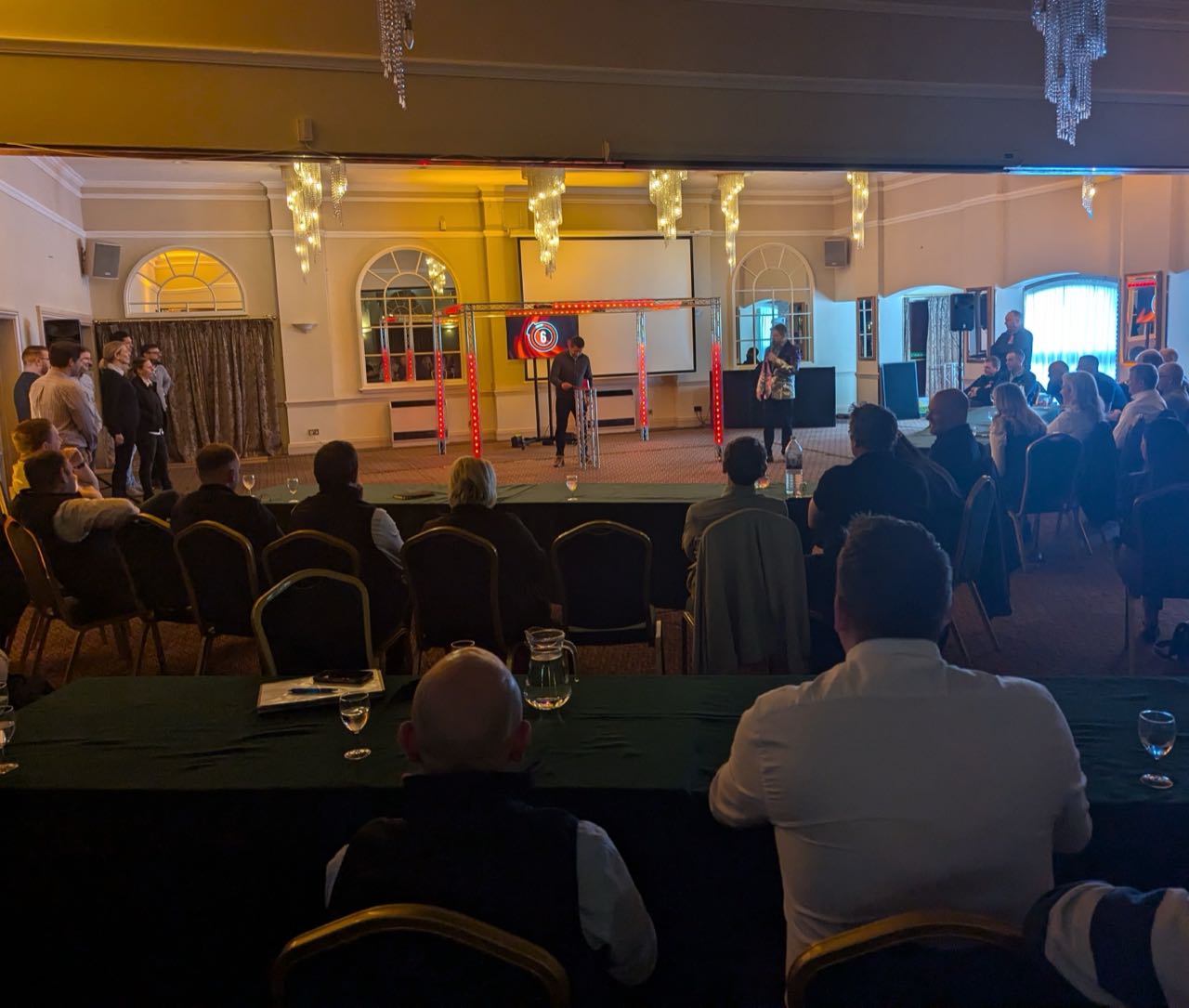
You’ve been asked to run indoor team building games for 100 people, and the usual icebreakers only work for 12. The short answer: use team-based games, not whole-room ones. For free, no-kit options, use story-telling, a sub-team human knot, a table scavenger hunt, charades relay or this-or-that. Past about 50 people, or if you want something memorable, hire a game. A presenter, stations and a scoreboard make it easier to run well.
The comparison table shows group size, space and who hosts each of the twelve games. In this article, “large group” means 30 or more people. That is an editorial line, not a limit on what we run.
Quick answer: the best fit by group size
Match the game to the headcount first.
- 30 to 50 people: free games in sub-teams, or Escape Room in a Box or CSI Investigation if you want something hosted.
- 50 to 100 people: game shows and quizzes, CSI Investigation, or The Betrayers. A host becomes worth the money here, because instructions stop carrying across the room.
- 100 to 500 people: AI Robot Wars or VR Escape Room (both up to 500 participants), or ask us about a game show for your headcount.
- Drop-in crowds: arcade stations, where nobody waits for a start signal.
What changes when a group gets big
Big groups fail in predictable ways. Plan for these five before you pick a game.
- Instructions don’t carry. Past about 40 people, anyone at the back misses the rules. You need a microphone, a screen, or a host. Better still, pick rules that fit in two sentences.
- One winner, 99 spectators. Games where individuals take turns in front of the room can lose everyone else within minutes. Choose games where every team plays at once.
- Queues at a single station. One arcade machine for 80 people is a queue, not a game. Run several stations in parallel.
- Timing drifts. Keep rounds short and build in a buffer.
- Room layout. Tables of 6 to 12 give you ready-made teams, make the scoreboard easy to read and stop people wandering off.
Free indoor team building games for large groups (no materials)
These five need no kit, no budget and almost no prep. They are fine for a team meeting or a breakout session, and they scale if you work in sub-teams rather than the whole room. Each assumes teams of 6 to 12.
1. Group story-telling
Time: 10 to 15 minutes. Space: wherever people already sit.
Each table builds a story one sentence at a time, passing it round. Give them an opening line, such as “The lift stopped between floors 3 and 4.” To scale it, ask each table to read out its story, or vote on the funniest through a show of hands.
2. Human knot in sub-teams
Time: 10 minutes. Space: clear floor, roughly an arm’s length around each group.
Teams of 8 stand in a circle, grab two different hands across it, then untangle without letting go. Run every team at once, not one giant knot, where most people would spectate. Offer a seated version for anyone who can’t stand or would rather not be touched, such as passing a loop of string.
3. Table scavenger hunt
Time: 10 minutes. Space: the room as it is.
Call out items teams must produce from pockets and bags, such as “a photo of a pet” or “a receipt from this month”. The first table to bring it up scores. For 50 or more, have a volunteer judge at each table and put the score on a screen or flipchart.
4. Charades relay
Time: 15 minutes. Space: a clear line or aisle per team.
Teams line up. The person at the front sees a word (film titles work well), acts it out, and the team guesses. When they get it, the actor goes to the back and the next person comes forward. Run lines in parallel and score by words guessed in five minutes. Let people who dislike acting guess or keep score.
5. This or that
Time: 5 minutes. Space: open floor, or just a show of hands.
Call out a choice (tea or coffee, mountains or beach) and everyone moves to one side of the room. It takes no prep, and it works with 200 people as easily as 20. Hybrid colleagues can vote in the chat instead.
Hosted indoor games for 50 to 500 people
Hired games remove what makes DIY hard at scale: the rules, the kit and the running order. For corporate events, setup, breakdown and all equipment are included, along with professional hosts, and custom branding is available.
6. Escape Room in a Box
Escape Room in a Box is part of our indoor team building range, which runs from 10 to 100+ people. That makes it a fit for the lower half of the group sizes in this article.
7. CSI Investigation
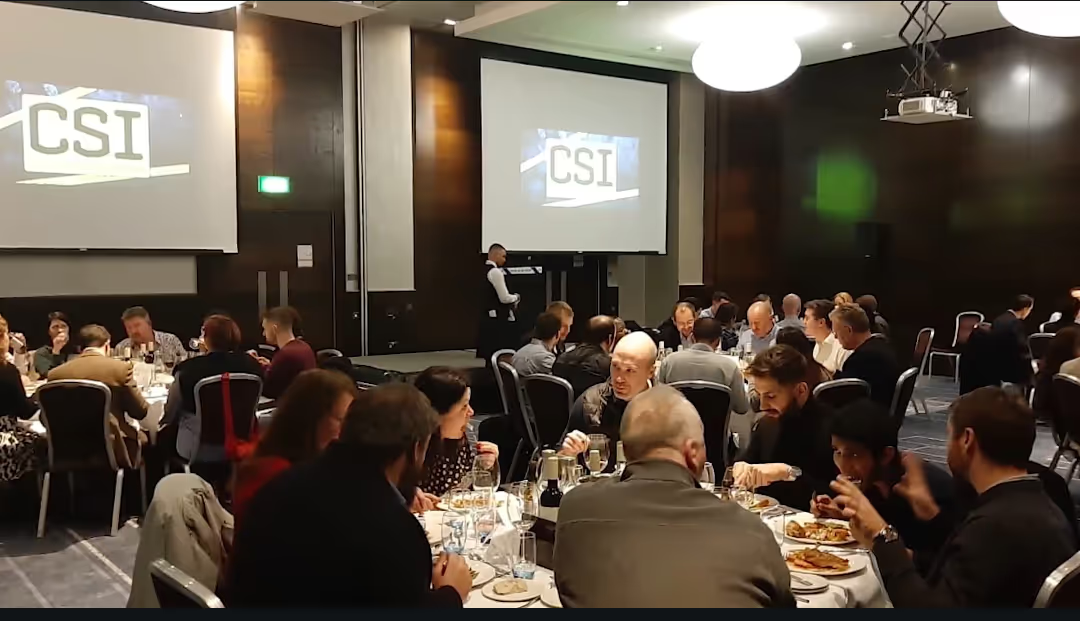
Teams investigate a staged crime scene, with numbered evidence markers and clues to work through. It is also in the indoor team building range (10 to 100+ people). It can run at round tables as dinner entertainment, with the CSI title shown on big screens.
8. AI Robot Wars
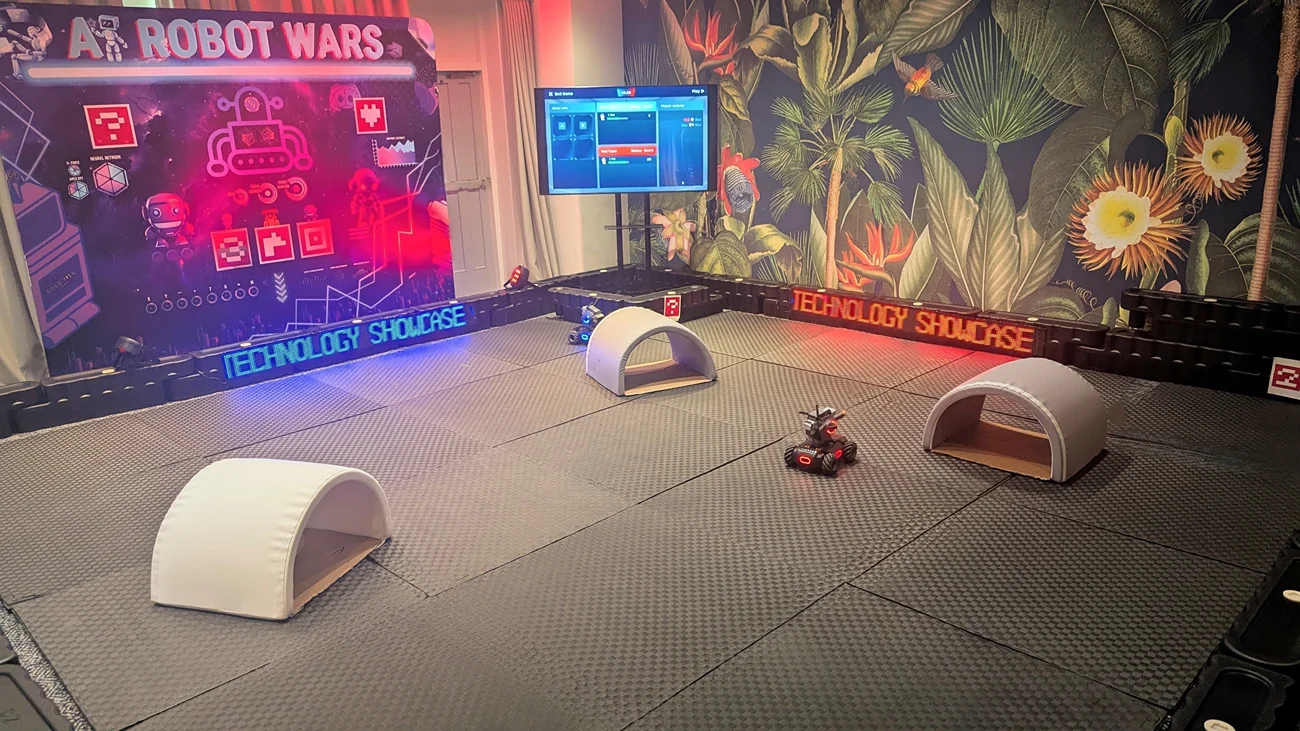
Teams of 6 to 12 steer AI robots round an arena built to fit your space, from a giant race track to a small arena. It runs for up to 500 participants, and nobody needs AI, robotics, coding or VR experience. See AI Robot Wars.
9. VR Escape Room
Teams of 4 to 10 work together at a table, with one player in the headset while the others work from the manual. Each team needs about 2×2 m (a table), and it runs for up to 500 participants. Nobody needs VR experience. Read more on the VR Escape Room page.
10. The Betrayers
Inspired by the TV show The Traitors, with bluffing, accusation and voting. It is adapted to the space and group size, from boardroom to conference hall, and comes with a professional presenter and all AV. Our Traitors-style game suits an evening session when you want the whole room talking.
11. Game shows and quizzes
Taskmaster-style challenges, Cube challenges, quizzes and bingo, customised around your company, with setup included. They suit a post-conference or end-of-day social, where teams stay seated while players take turns on stage. Ask us about numbers for your room. See our game shows and quizzes.
12. Arcade stations
Retro arcade (Street Fighter, Pong, Pac-Man), air hockey, table football, darts, shuffleboard and beer pong. It runs as a free-flow, drop-in format, so people play when they like instead of waiting for a start signal. That suits guests who dislike organised games.
“We used Gold Tier Events for an after-conference social with 250+ guests, and I cannot say enough good things about Reece and his crew.” — Jonathan Behr, CTO / VP of Engineering, Laravel Live
Comparison table
| Game | Group size | Space | Kit | Host |
|---|---|---|---|---|
| Story-telling | Any, in tables | Seats only | None | No |
| Human knot | Any, in teams of about 8 | Clear floor | None | Helpful |
| Table scavenger hunt | Any | Seats only | None | A judge per table |
| Charades relay | Any, in lines | Aisle per team | Word slips or a screen | Helpful |
| This or that | Any | Open floor | None | No |
| Escape Room in a Box | 10 to 100+ (indoor range) | Ask us | Supplied | Professional host included |
| CSI Investigation | 10 to 100+ (indoor range) | Round tables | Supplied | Professional host included |
| AI Robot Wars | Teams of 6 to 12, up to 500 | Arena to fit your space | Supplied | Professional host included |
| VR Escape Room | Teams of 4 to 10, up to 500 | About 2×2 m per team | Supplied | Professional host included |
| The Betrayers | Boardroom to conference hall | Adapted to the room | Supplied | Professional presenter included |
| Game shows and quizzes | Ask us for your headcount | Stage and tables | Supplied | Professional host included |
| Arcade stations | Drop-in | Floor space for stations | Supplied | No start signal needed |
How to run any game with a big group
These habits matter more than which game you pick.
- Make teams of 6 to 12 before people sit down. Mix departments, and assign tables with place cards.
- Show the scoreboard. A screen or flipchart keeps energy up and stops arguments.
- Give a clear start and end. Say how long each round lasts, then stick to it.
- Mix the abilities. Rotate roles so the same people don’t dominate.
- Plan for non-drinkers. Don’t let any game depend on drinking.
- Include remote colleagues. Give hybrid staff a role, such as scorer or judge, or a game that can run through chat.
- Think about neurodiversity. Share the format in advance, avoid forced touching and let people opt out of the stage.
Always confirm accessibility and venue rules, such as capacity limits, with your supplier and venue before you commit.
Choosing a game
Pick on the room first, then the people, then the budget.
- Room size and layout. Count the tables, not just the square metres.
- Ceiling height. Check requirements with the supplier of any third-party game.
- AV. A microphone and a screen make big rooms workable. The Betrayers comes with all AV.
- Budget. Free games cost only your time. For hosted games, ask for a proposal.
- Introverts and extroverts. Offer a seated team game and a drop-in option.
If you are still unsure, our team building events page shows how these games fit a wider day. If the weather is kind, outdoor team building is the alternative.
FAQs
What are some good team building games for groups?
For groups of 30 or more, pick games built around teams, not individuals. Free options include a table scavenger hunt, charades relay and a this-or-that movement icebreaker. Hosted options include game shows, CSI Investigation and AI Robot Wars. The comparison table above shows group size, space and who hosts each one.
What are the 10 indoor games?
This article covers twelve. The ten most useful for big groups are group story-telling, human knot in sub-teams, table scavenger hunt, charades relay, this-or-that, Escape Room in a Box, CSI Investigation, AI Robot Wars, VR Escape Room and game shows. The Betrayers and arcade stations make up the other two.
What are some fun and engaging party games for adults?
Adults tend to enjoy games with a bit of theatre and a clear winner. The Betrayers, our Traitors-style game, suits an evening with a presenter and a lot of accusing. Game shows and quizzes, with Taskmaster-style and Cube challenges, work well after a conference. Arcade stations give a drop-in option for people who would rather not perform.
What is a good 5-minute no-prep team building activity?
This-or-that is the quickest. Name two options, such as tea or coffee, and ask people to move to opposite sides of the room. It takes about five minutes, needs no materials and works for any size of group. Finish by asking each side to explain its choice to a neighbour.
Ready to run one?
Tell us about your event and we’ll put together a tailored proposal. Send us your enquiry with your headcount, date and room, and we’ll reply within one business day.