Office Game Show Ideas: 12 Formats to Run at Work
A colleague has asked you to “sort something fun” for Friday, or the end-of-day slot at your conference needs filling. Office game show ideas are the safe answer: everyone already knows how one works.
The right format depends on the room. Quizzes, bingo and Taskmaster-style challenges suit 10 to 30 people, while Cube-style rounds and buzzer teams suit bigger rooms. Whatever you pick, it needs a confident host, scoring everyone trusts and a fast pace.

What makes an office game show work
A game show works when four things are in place: a host who owns the room, scoring that feels fair, a quick pace and a way for the audience to join in. Most that fall flat fail on one of these four.
- The host. A weak host means rules are explained three times and the energy drops. If a colleague is hosting, give them a script and a stopwatch.
- Scoring. Disputed points kill the mood. Decide the scoring before you start, and have one person (not the host) keep the tally.
- Pace. Dead time between rounds is the usual culprit. Reset props while the previous round is being scored, and keep each round to a few minutes.
- Involvement. Don’t force shy people on stage. Let teams choose who plays, and give everyone else a job: guessing, voting or cheering.
Simple office game show ideas for small teams (10-20 people)
Small teams don’t need staging, which makes game shows an easy team building win. A meeting room or an open-plan corner is enough, and a handful of props does the rest.
1. Taskmaster-style challenges
Teams get odd tasks with simple rules, such as getting a ball into a cup from the far side of the room using only stationery. A judge awards points for speed and creativity. It suits mixed teams because the tasks reward lateral thinking, not knowledge. Allow 45 to 60 minutes and a table of cheap props. We cover the format in more depth in our Taskmaster team building guide.
2. Office pub-quiz rounds
Four or five rounds of ten questions: general knowledge, a picture round, a music round and one round about your own company. The company round is the one people talk about afterwards. Keep it to about an hour.
3. Guess the colleague
Collect a childhood photo or a surprising fact from each person in advance, then have teams guess who it is. It needs no kit and works well for new teams or departments that rarely meet.
4. Bingo with a twist
Swap numbers for office in-jokes, meeting clichés or “find someone who” squares. It is the lowest-effort option here, and it’s easy for people who don’t want to perform in front of colleagues.
Bigger-room game show formats (30-200+ people)
Bigger rooms need a stage or a clear playing area, a screen everyone can see and a host with a microphone. Most of the room watches, so choose formats that are fun to spectate.
5. Cube-style challenges
Individual players or pairs attempt a timed physical task inside a marked frame, such as moving balls between boxes or balancing a platform, while their team shouts advice. They are quick to run, easy to follow from the back of the room and make for good spectating. We run Cube challenges as part of our game shows and quizzes.
6. Buzzer quiz teams
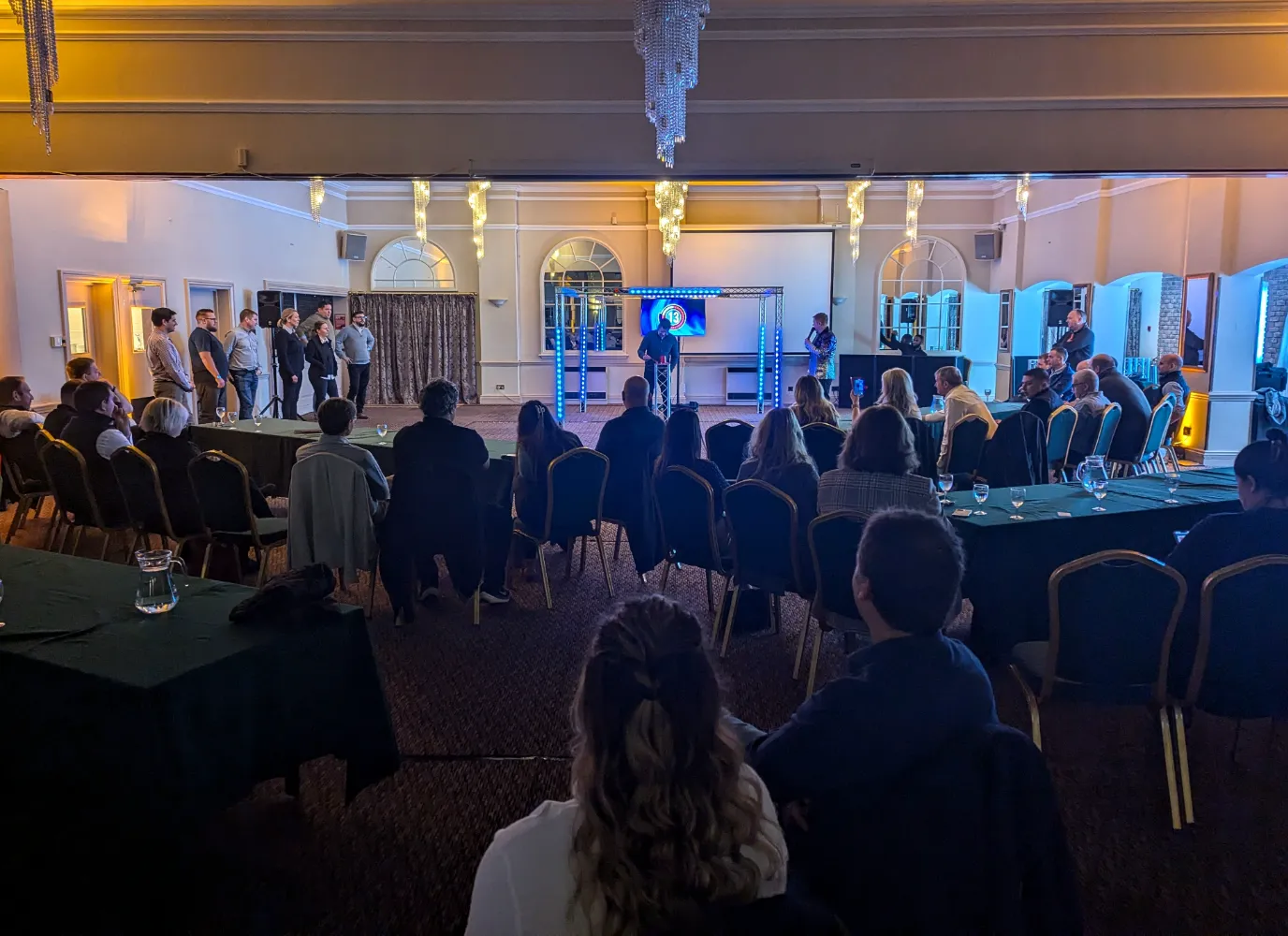
Tables compete as teams, with a buzzer or a hand-up system and a scoreboard on screen. Keep questions short and mix difficulty so no table is out of the running by round two.
7. Traitors-style deduction games
A few players are secretly “traitors” and the rest must work out who. It needs a good presenter and some atmosphere, but it works from a boardroom to a conference hall. Our version, The Betrayers, is inspired by The Traitors, with a professional presenter and AV included. If you want to try the format yourself first, see our Traitors-style team building game guide.
Funny and low-prep ideas for a Friday afternoon
If you have 30 minutes and no budget, aim for laughs over competition. These need a laptop, a screen and perhaps a box of props.
8. Caption this
Show a funny photo (a company-approved one, or a stock image) and let teams write the best caption. Vote by applause.
9. Two truths and a lie, with a scoreboard
Each team presents three “facts” about a team member. The other teams vote on which one is false. It is quick, and it teaches people something new about each other.
10. Mini Cube challenges at desks
Set a 30-second task using desk items: stack paper cups, flip a pen into a mug or pass a ball along a line. Run them as heats and keep score on a whiteboard.
Virtual and hybrid game show ideas
Remote staff only enjoy a game show if they can score, not just watch. Use a quiz tool or polls so everyone plays on equal terms, and put a host on the video call as well as in the room.
11. Virtual pub quiz
A shared screen, breakout rooms for team discussion and one person reading questions. Keep rounds short because attention drifts faster on video. Our hybrid team building ideas guide covers how to keep both groups involved.
12. Picture bingo on a call
Share a bingo card by email and call out images instead of numbers. Remote and in-office staff can play side by side, and the person who finishes first just unmutes and shouts.
Indoor or outdoor?
Indoor is the default, but outdoor game show formats suit summer socials and away days. Sports-day classics like sack races and tug of war, Wipeout-style inflatables and Crystal Maze-style puzzles all borrow from game shows. See our outdoor team building and indoor team building options, which cover groups from 10 to 100+ indoors. For more ideas to pair with a game show, read our office team building activities guide.
Run it yourself or hire a host
You can run a quiz or bingo yourself. For bigger or more ambitious formats, a professional host removes most of the risk. Use this checklist to decide.
- Space: can everyone see and hear the host? Is there a clear playing area?
- AV: do you have a microphone, a screen and a way to show scores?
- Scoring: who keeps the tally, and who settles disputes?
- Prizes: keep them modest and decide them beforehand. If alcohol is involved, offer an alternative.
- Props: have spares and test them before people arrive.
- Inclusion: can everyone take part? See below.
If the checklist raises more questions than answers, hiring a host is simpler. Our corporate events include setup, breakdown, all equipment and professional hosts, with company-themed customisation available for game shows.
Making it inclusive
An inclusive game show lets people choose how they take part. Plenty of colleagues would rather score, vote or guess than play on stage.
- Non-drinkers: don’t make drinks part of the game or the prize.
- Mixed ability: include physical, mental and creative rounds so different strengths count.
- Shy players: let teams nominate players, and give non-players a role.
- Neurodiversity: explain the rules clearly and in writing, and avoid sudden noises or surprises without warning.
- Remote staff: make sure they can score in real time.
If you have specific access needs in the group, tell your supplier early so they can adapt the format.
How we run game shows
Our Game Shows & Quizzes include Taskmaster-style challenges, Cube challenges, quizzes and bingo, customised to your company, with setup included. They suit a post-conference or end-of-day social.
We provided post-conference entertainment for Laravel Live. Their CTO and VP of Engineering, Jonathan Behr, said: “We used Gold Tier Events for an after-conference social with 250+ guests, and I cannot say enough good things about Reece and his crew.”
FAQs
What are some fun game show ideas for work?
Good starting points are Taskmaster-style challenges, a team pub quiz, bingo, Cube-style timed challenges and a Traitors-style deduction game. Pick by room size: quizzes and challenges suit 10 to 30 people, while Cube-style and buzzer rounds work well for bigger rooms where most people watch and cheer.
What games can we play at work?
Low-prep options include a ten-question quiz, office bingo, “guess the colleague” with baby photos or fun facts, and a team challenge using stationery. Each runs in 15 to 30 minutes with no special equipment, so you can fit one into a Friday afternoon or the end of a team meeting.
What are some fun activities to do during work meetings?
Keep them to five or ten minutes: a quick-fire quiz round, a one-minute challenge with desk items, or picture bingo on the screen. Short rounds break up a long agenda without eating into the meeting, and they work well for hybrid teams as long as remote staff can score too.
What is a popular game show?
Formats most people already know include Taskmaster, The Cube and The Traitors, and they translate well to work events because the rules are easy to explain. We run Taskmaster-style challenges, Cube challenges, quizzes, bingo and a Traitors-inspired game called The Betrayers.
Tell us about your event and we’ll put together a tailored proposal. Send us your enquiry and we’ll reply within one business day.