Team Building Activities for New Teams: 12 Ideas
A new team has a short window where everyone is polite, a bit guarded and unsure who to ask for what. The right team building activities for new teams can shorten that window. For people who have just met, pick something low-pressure and structured, such as 20 questions or a puzzle in small mixed groups. Save the louder, competitive formats for later, once people have worked together for a few weeks.
This guide groups 12 ideas by how well your people know each other, with the practical details (group size, space, how much talking is involved) that most lists skip. We run team building events across the UK, so the detail on delivered formats comes from what we actually set up.
Why the first weeks matter, and what new teams actually need
New teams usually need three things early: to learn each other’s names and roles, to find out how colleagues like to work, and to feel safe enough to ask a “silly” question. Team building helps with all three when it gives people something to do together, rather than something to perform in front of strangers.
The common mistake is treating a new team like an established one. Established teams handle banter and rivalry; a team that met on Monday cannot. A low-stakes task with a clear goal lets people talk about the task first and each other second.
How to choose team building activities for new teams
Choose by four things: group size, available space, energy level and how much talking the activity demands. If people barely know each other, favour tasks that give them something to look at, hold or solve together, so conversation happens around the task rather than being forced.
| Activity | Best for | Space | Energy | Talking demanded |
|---|---|---|---|---|
| 20 questions | Any size, just met | Any room or video call | Low | Medium |
| User manual of me | Up to about 15 | Any, or a shared document | Low | Low |
| Speed-networking rounds | 10 to 40 | A room with movable chairs | Medium | High |
| VR Escape Room | Teams of 4 to 10 | About 2×2 m per team (a table) | Medium | Medium |
| Indoor formats (CSI, Escape Room in a Box) | 10 to 100+ | A function room or large office | Medium | Medium |
| AI Robot Wars | Teams of 6 to 12 | Tailored to the space | Medium to high | Medium |
| Tablet Treasure Hunt | Teams moving around on foot | Outdoors | Medium | Medium |
| Game shows and Taskmaster-style | Teams of colleagues at tables | A function room | High | Low |
| The Betrayers | Small to large groups | Boardroom to conference hall | Medium | High |
Low-pressure starters for people who’ve just met
These five need no kit and no supplier. They work in a meeting room, a kitchen area or on a call, and each takes 10 to 20 minutes. Use one or two, not all five.
Two truths and a lie
Each person shares three statements about themselves, two true and one false, and the group guesses the false one. For new teams, set one rule: keep the truths work-safe and low-stakes (a job you once had, somewhere you’ve lived, a food you hate). It gives people something to remember each other by without anyone having to share anything uncomfortable.
20 questions
In the classic version, one person thinks of something and the group asks up to 20 yes-or-no questions to identify it. For new teams, run it about people instead. Each person picks a hobby, a place or an object that matters to them, and the group questions them. Good question types for new colleagues are “Is it something you do outdoors?”, “Did you learn it as a child?” and “Would I find it in your kitchen?”
Split larger teams into groups of four to six so everyone gets a turn.
User manual of me
Each person writes a short guide to working with them: how they like to receive feedback, when they do their best thinking, what they find hard to deal with in meetings, and the best way to reach them. Share them in a team document. It is quiet, so it suits introverts.
Speed-networking rounds
Pair people for three-minute conversations from a short list of prompts, then rotate. Choose prompts that are about work and interests, such as “What’s the best thing you’ve worked on?” or “What would you want a new colleague to know about you?”
Lunch-and-learn show and tell
Over lunch, each person has two minutes to show one object, photo or website that says something about them. Keep it optional and give a day’s notice so nobody is put on the spot.
Collaborative challenges that build trust
Once people have had a few conversations, give them a shared problem to solve. A common goal in small mixed groups lets the puzzle do the social heavy lifting. These four formats are ones we deliver.
VR Escape Room
Our VR escape room gives each team a shared task, with one person in the headset and teammates at the table. Everyone has something to contribute, so quieter people don’t have to present. Teams are 4 to 10 people, it works for up to 500 participants, and each team needs about 2×2 m, which is a table. No VR experience is needed.

Indoor team building formats
Our indoor range includes CSI Investigation, Paint Pad Pro, Escape Room in a Box and arcade stations, for groups from 10 to 100+. CSI Investigation is a good fit for new teams because colleagues work through clues together, so people talk about the evidence before they talk about themselves.

AI Robot Wars
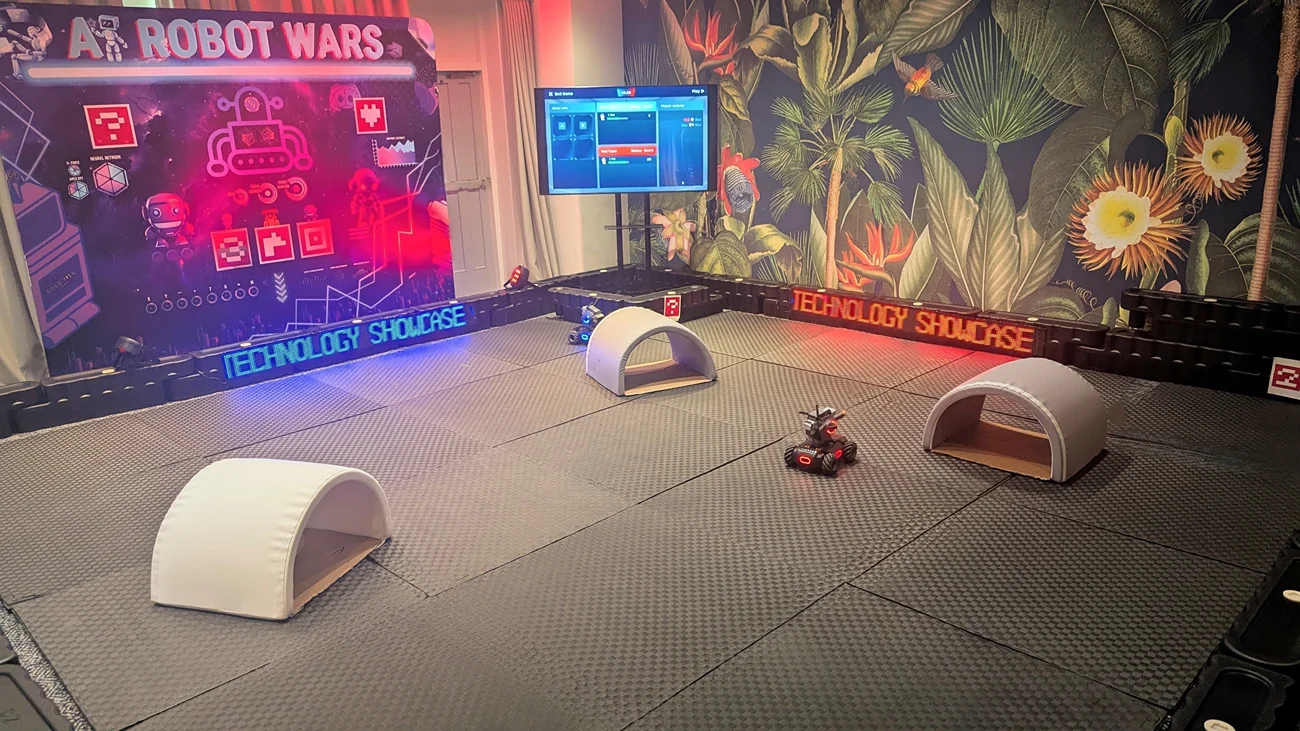
AI Robot Wars pits teams of 6 to 12 against each other in an arena tailored to the space, from a giant race track to a small arena, for up to 500 participants. No AI, robotics, coding or VR experience is needed, so nobody needs a technical background to take part.
Tablet Treasure Hunt
The Tablet Treasure Hunt sets outdoor, geotagged challenges on tablets, with prizes for the winning team. Moving between locations in small groups gives people time to chat naturally. It suits a team with time set aside and decent weather.
Higher-energy options once the ice is broken
Once colleagues have worked together for a few weeks, you can add rivalry and noise. Avoid these in week one: they reward confidence, and a new team hasn’t yet built the trust that makes failing in front of colleagues feel safe.
Game shows and Taskmaster-style challenges
Our game shows and quizzes include Taskmaster-style challenges, Cube challenges, quizzes and bingo, with company-themed customisation and setup included. Players take on challenges on stage while the rest of the room watches, so people can join in at their own pace.

The Betrayers
Inspired by the TV show The Traitors, The Betrayers is a hidden-role game of suspicion and persuasion, adapted to the space and group size from boardroom to conference hall. A professional presenter and all AV are included. It is heavy on talking and bluffing, so keep it for a team that has already settled in.
Outdoor formats
Our outdoor range includes sports-day classics such as the sack race and tug of war, Wipeout-style inflatables, Crystal Maze-style puzzles, archery, axe throwing and more. These are physical and noisy, so they suit a team with some rapport. Confirm safety and access requirements with your supplier.
Virtual and hybrid new teams
For remote or hybrid new teams, keep sessions short, structured and in small groups. Two truths and a lie, a user manual of me and a hosted quiz all work on video. Long, open-ended chats do not.
If half the team is in a room, don’t leave remote people watching a group laugh. Mixed teams with one remote person per group, and shared documents, help.
Making it inclusive
Check three things before you book: who might find the format uncomfortable, what access needs people have, and whether the occasion centres on alcohol. Ask people privately and early, and confirm any access, dietary or physical requirements with your supplier before the day.
- Introverts: choose formats with defined roles, such as the VR Escape Room, or written activities such as a user manual of me. Avoid forcing anyone to speak to a full room.
- Non-drinkers: don’t build the activity around a bar.
- Mixed abilities and neurodiversity: give clear rules in writing beforehand, and avoid activities that depend on speed, noise or surprise unless people can step out.
Mistakes to avoid with new teams
Most new-team activities go wrong in the same four ways.
- Forced sharing. Asking people to share personal stories before there is any trust makes it worse. Keep prompts light and let people pass.
- Too competitive too soon. A leaderboard on day one turns first impressions into scores. Use mixed teams and keep early prizes light-hearted.
- Big drinking events. An evening built around alcohol excludes some colleagues and sets an awkward tone for a new team. Use daytime or low-alcohol formats first.
- No follow-up. One session doesn’t build a team. Plan a second touchpoint, even a simple one such as a team lunch a few weeks later, so the connections made have something to land on.
When to bring in a supplier
DIY is fine for small groups with a simple goal. Bring in a supplier when you have a larger group, or when you’d rather join in than referee. Our corporate events run for 20 people or 2,000.
What’s included: full event planning and coordination, setup, breakdown and all equipment provided, professional hosts, and a free venue finding service as standard. Custom branding and theming is available too. Our client from Howdens put it simply: “Gold Tier arrived at the exact time they said they would, they set everything up ready for the start of our event.” (Diane Collins, Business Developer, Howdens.)
If you’re weighing up formats for a new team, our team building service covers the options. You can also compare the indoor team building and outdoor team building ranges.
FAQs
What are some fun and easy team building games?
Start with two truths and a lie, 20 questions and a user manual of me. They need no kit and no preparation beyond a few minutes of explanation. For something more hosted, a quiz or a Taskmaster-style challenge is easy to follow and gets people laughing in teams of mixed colleagues without anyone having to perform alone.
What is the purpose of team building?
Team building gives colleagues a shared experience so they can work out how each other thinks, communicates and solves problems before real deadlines arrive. For a new team, the aim is simple: reduce the awkwardness of early days so people ask questions, share ideas and ask for help sooner.
What is the 20 questions game for team building?
One person thinks of something, such as an object, a place or a colleague’s hobby, and the group asks up to 20 yes-or-no questions to guess it. For new teams, switch it to people: each person picks something about themselves and the group questions them. It reveals interests without anyone having to give a speech.
Are there team building activities for new teams that work remotely?
Yes. Short, structured formats work best on video: two truths and a lie in small breakout groups, a user manual of me shared in a document, or a hosted quiz in mixed teams. Keep sessions brief, give everyone a clear role and avoid anything that depends on fast back-and-forth across a bad connection.
Tell us about your event and we’ll put together a tailored proposal. Send us an enquiry and we’ll reply within one business day.